

Follow the presentation
Gibbons, R. (1992). A Primer in Game Theory
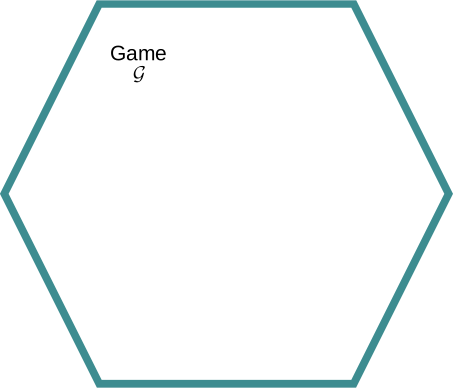
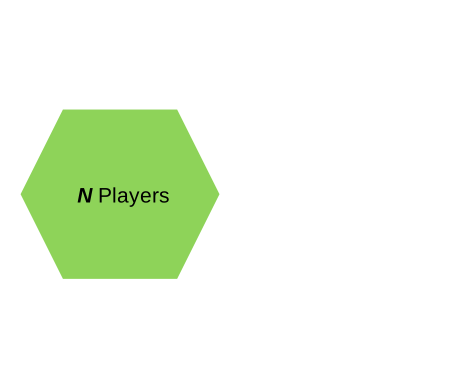
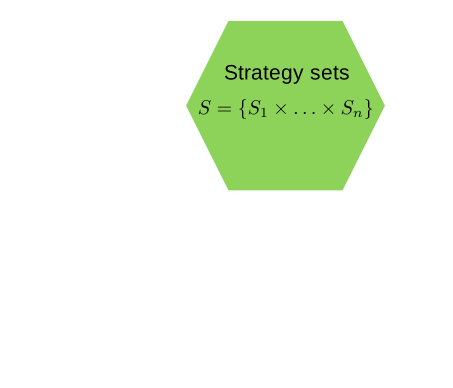
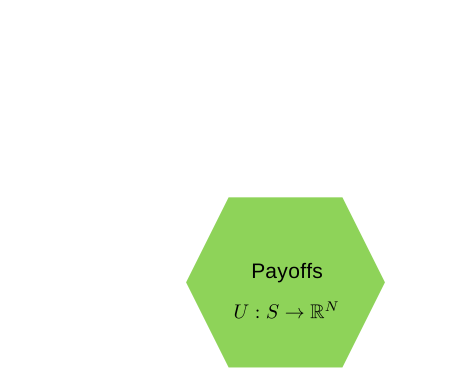
Normal-Form Representation: \[ \mathcal{G} = \{N,S = S_1 \times ... \times S_N, U:S \rightarrow \mathbb{R}^N\} \]
| Yes → Static | No → Dynamic |
| Yes → Complete Information | No → Incomplete Information |
| Yes → Perfect Information | No → Imperfect Information |
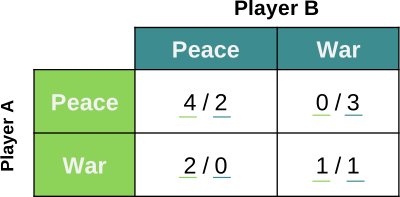


If players are rational, what is the most likely game outcome?
It depends on the game conditions!
Nash-Equilibrium (NE)
Steady state where no player can benefit by unilaterally changing its strategy.
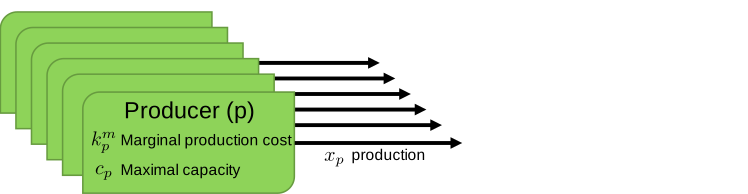
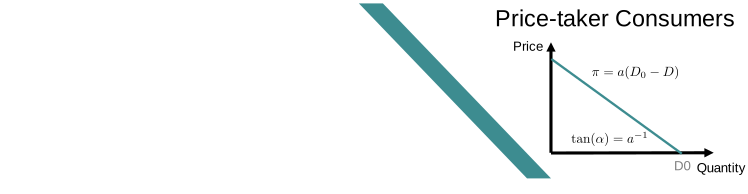
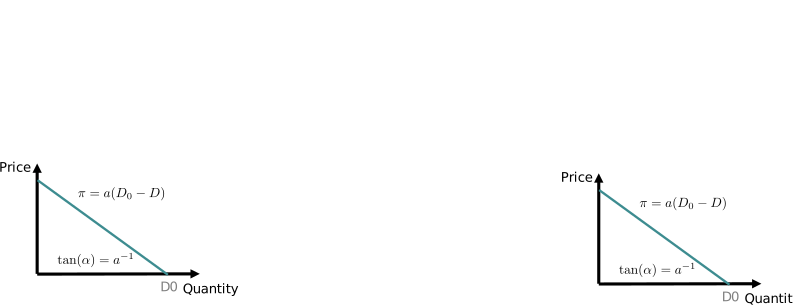
\[\begin{aligned} \max_{x_p} &\left(\pi - k^m_p\right) x_p \\ \text{s.t.}&\\ & \sum_{p' \in P}x_{p'} = D \\ & \pi = a(D_0 - D)\\ & c_p - x_p \geq 0 \end{aligned}\]
\[\begin{aligned} 0 = \pi - aD - k_p^m -\alpha_p &\perp x_p \text{ free} \; \; \forall p\\ 0 \leq c_p- x_p &\perp \alpha_p \geq 0 \; \; \forall p\\ 0 = \pi - a(D_0 -D) &\perp \pi \text{ free}\\ 0 = \sum_{p' \in P} x_{p'} - D &\perp D \text{ free} \\ \end{aligned} \]
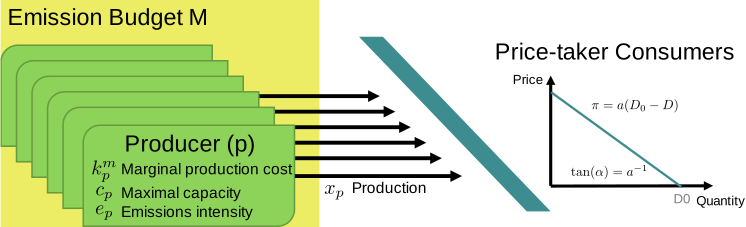
\[\begin{aligned} 0 = \pi - aD - k_p^m &\perp x_p \text{ free} \; \; \forall p\\ 0 \leq c_p- x_p &\perp \alpha_p \geq 0 \; \; \forall p \\ 0 \leq M - \sum_{p'} x_{p'}e_{p'} & \perp \phi_p \geq 0 \; \; \forall p\\ 0 = \pi - a(D_0 -D) &\perp \pi \text{ free} \\ 0 = \sum_{p' \in P} x_{p'} - D &\perp D \text{ free} \\ \\ \end{aligned} \]
\[
0 \leq M - \sum_{p'} x_{p'}e_{p'} \perp \phi_p \geq 0 \; \; \forall p\\
\]
The strategy set of each player depends on the strategies of the other players. (GNE)
This system is non-square !!!
If a trading system is implemented, the prices of the permits are the same for all producers, i.e,
\[ \phi_p = \phi \; \; \forall p \]
The system is now square and has an unique NE.
\[\begin{aligned} 0 = \pi - aD - k_p^m &\perp x_p \text{ free} \; \; \forall p\\ 0 \leq c_p- x_p &\perp \alpha_p \geq 0 \; \; \forall p \\ 0 \leq M - \sum_{p'} x_{p'}e_{p'} & \perp \phi \geq 0 \; \; \forall p\\ 0 = \pi - a(D_0 -D) &\perp \pi \text{ free} \\ 0 = \sum_{p' \in P} x_{p'} - D &\perp D \text{ free} \\ \\ \end{aligned} \]
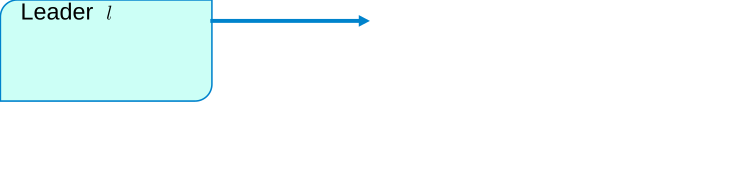
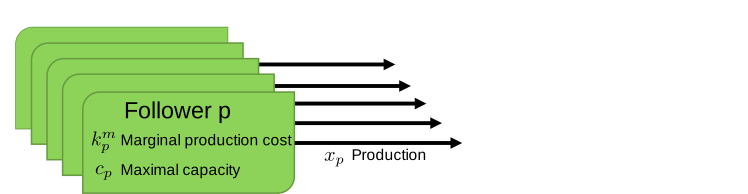
Leader plays first, followers observe and then play a cornout-competition game.
\[\begin{aligned} &\max_{x_l} \pi x_l - k_l^m x_l \\ & \text{s.t.} \\ &c_l - x_l \geq 0 \\ &\text{NE Problem from Example 1} \end{aligned} \]
Note that the NE problem is now a constraint of the leader problem.
This is a bilevel problem, where the lower level is a NEP.
Complementarity conditions can be replaced by a non-linear transformation.
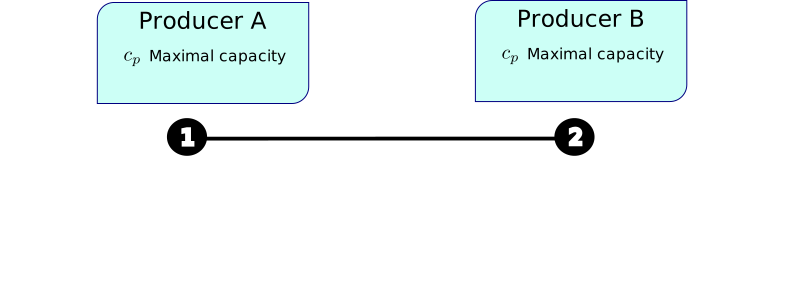
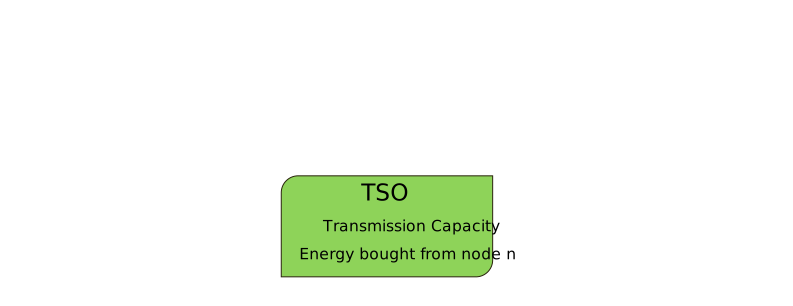
Two producers A and B (leaders) maximize their profits from energy sales.
TSO (follower) maximizes profit from energy arbitrage between nodes.
Adapted from Complementarity Modeling in Energy Markets, by Gabriel A., Conejo A., Fuller J., Hobbs B. and Ruiz C. (2013)
\[\begin{aligned} &\max_{s_n} \sum_{n \in N} \phi_n s_n \\ & \text{s.t.} \\ & s_1 - C \leq 0\\ & - s_1 - C \leq 0 \\ \end{aligned} \]
MPEC Formulation of leader at node \(n\) Problem:\[\begin{aligned} &\max_{x_{n}} \pi_{n} x_{n} \\ & \text{s.t.} \\ & x_{n} - c_{n} \leq 0 \\ & x_{n} - s_{n} = D_{n} \; \; \forall n \in N \\ & \pi_n = a_n(D_{0,n} - D_n) \; \; \forall n \in N \\ & \text{Follower Problem KKT Conditions} \\ \end{aligned} \]
Note that we have two MPEC problems, one for each leader → EPEC.
How solve a EPEC?
The most common strategy is Diagonalization
1. Define a initial set of strategies for the leaders
2. While not convergence and not max iterations
3. For each leader \(l\):
i. Solver the Leader \(l\) MPEC problem, given the strategies of the other leaders
ii. Reset the strategies of the leader \(l\) with the new strategies
4. Check convergence
5. If interation limit reached → algotithm failed
6. If not converged, go to 2, else finished
Implementation in Julia available here.
- Game theoretical fomulations allow to model imperfect markets.
- Given convex objetive functions and constraint qualifications, multiple interdependent optmization problems can be replaced by their KKT-Conditions.
- GNE problems can lead to non-square models, real world assumptions may help to eliminate variables.
- MPECs can be solved with non-linear transformations of complementarity constraints.
- EPECs can be solved used diagonalization.
Julia examples:
https://github.com/JP-Barbosa/GT4EM
This presentation
https://jp-barbosa.github.io/RevealGT4EM/
Questions, comments or ideas?
mail@juliabarbosa.net